Find, score and scan every AI model across code and cloud
Every model running from your code to your cloud is your risk, whether or not anyone told you it was there. FireTail finds them all, scores each one, scans them on a schedule, and hands you the evidence your board or an auditor will accept.

Every model running from your code to your cloud is your risk, whether or not anyone told you it was there. FireTail finds them all, scores each one, scans them on a schedule, and hands you the evidence your board or an auditor will accept.
FireTail discovers the models across your cloud accounts and code repositories, scores each one for risk, scans them on a schedule, and maps every finding to the frameworks your auditors already use. You end up with one prioritised list of model risk, and the proof you are on top of it.
The models putting you at risk are the ones nobody wrote down
Your teams are adopting models faster than anyone can govern them. A platform team stands up a foundation model on AWS Bedrock to serve an internal product. a data scientist hardcodes an open-source model into a service and pushes it to a repo. An engineer hardcodes a model reference into a service and ships it on a Friday.
None of that passes a review that asks what the model can do, how it behaves, or which regulation now applies. You carry the risk for all of it.
So when someone asks for the list of models in production, it gets rebuilt by hand across a dozen accounts and repositories, and it is already out of date by the time it is finished.
Find every model
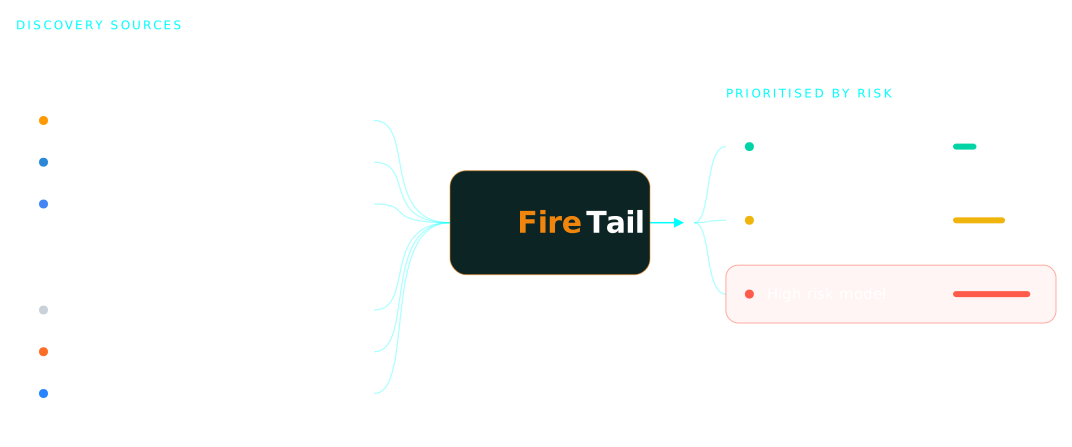
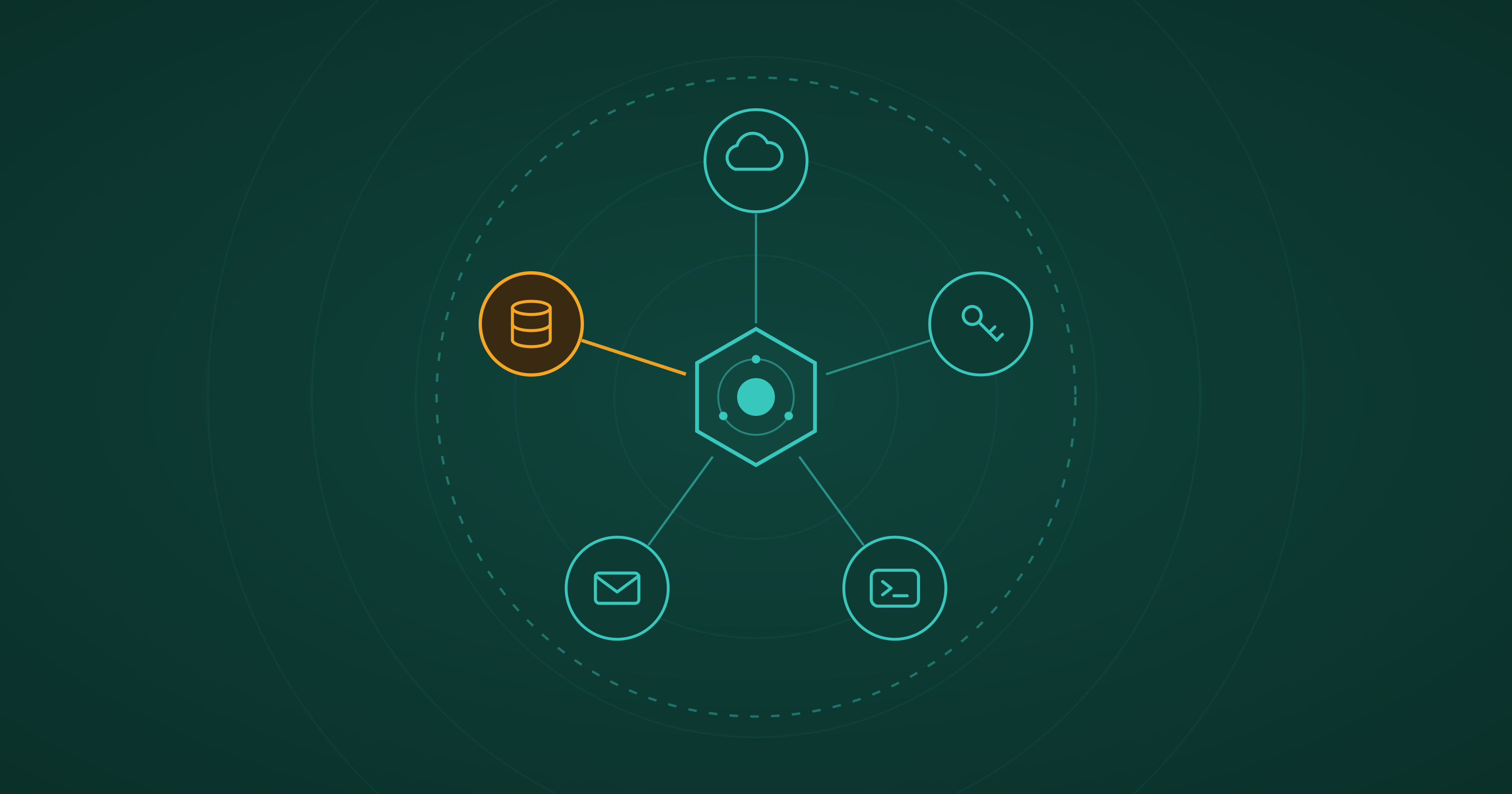
FireTail builds the inventory first. Cloud connectors read AWS Bedrock, Azure AI and Azure OpenAI. Repository scanning reads GitHub, GitLab and Bitbucket, where models often sit hardcoded next to the credentials that call them. Discovery reaches Google Vertex AI as well.
Each model arrives with its provider, its cloud and region, the project it belongs to, when it was first seen, and a risk score. A model running in a region you forgot you had enabled shows up next to everything else.
The riskiest model in an inventory is rarely the governed one the platform team is proud of. It is more often the instance sitting in a project nobody owns, still answering calls long after the work that created it finished. One inventory is what puts that model in front of you.
Every model scored and scanned on a schedule
Discovery confirms a model exists. Scanning shows whether it is safe to keep running. FireTail runs scheduled scans across the discovered models and returns a risk score from 0 to 100 for each one, with the findings that explain it.
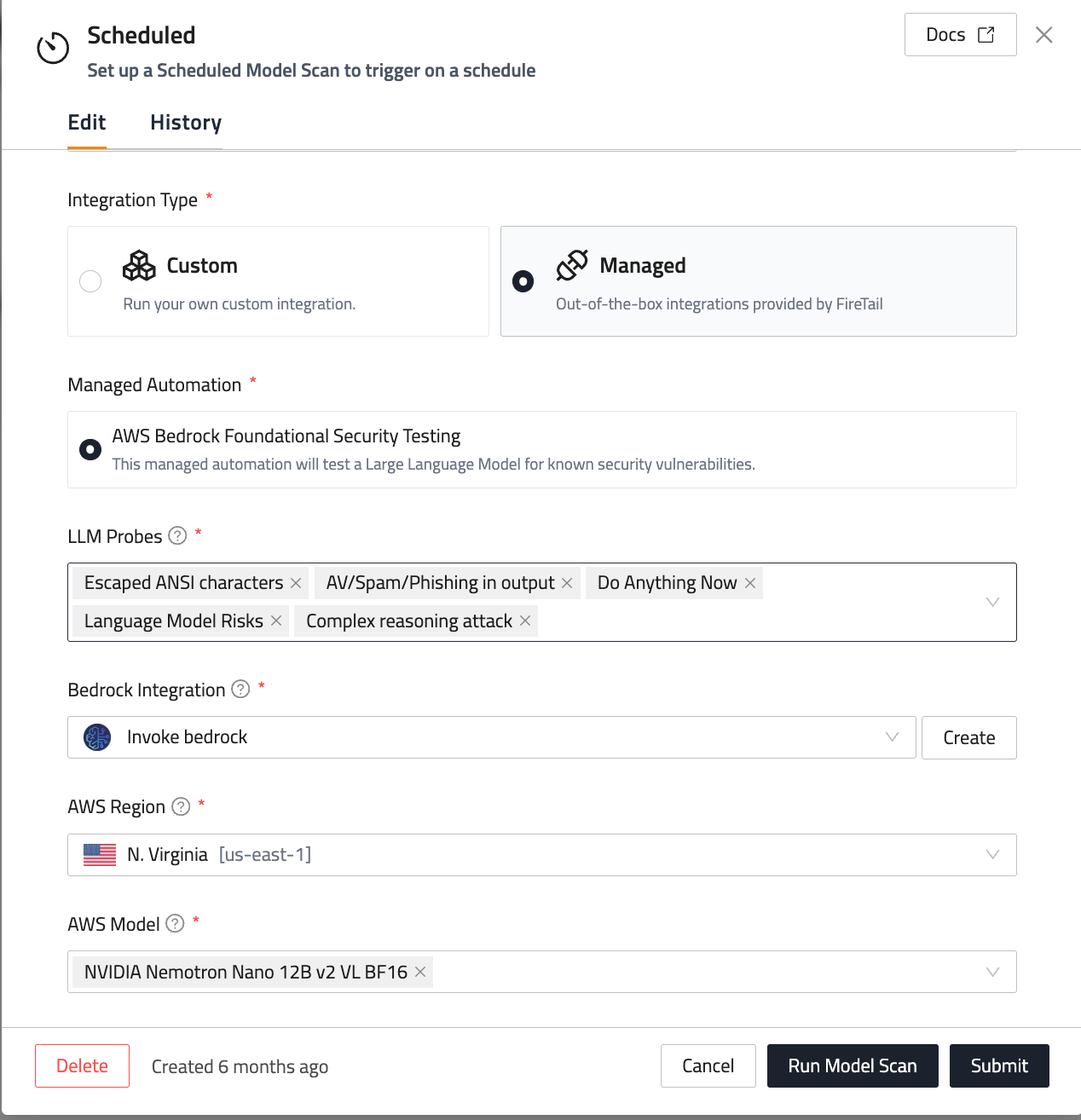
The findings name specific weaknesses rather than a vague sense that something is off. The ones worth a CISO's attention:
- Package hallucination. The model recommends software packages that do not exist. An attacker can register one of those names and wait for a developer to install it, which turns a model quirk into a supply chain foothold.
- No output scanning. The model's responses are leaving without any check on what they contain.
- Prone to harmful content. The model will produce material your policy does not allow.
- Multilingual content detected. Risk sitting in languages your reviewers do not read, scored the same as English so it does not slip past.
- PII in the logs. Personal data is turning up in model interactions that should never have carried it.
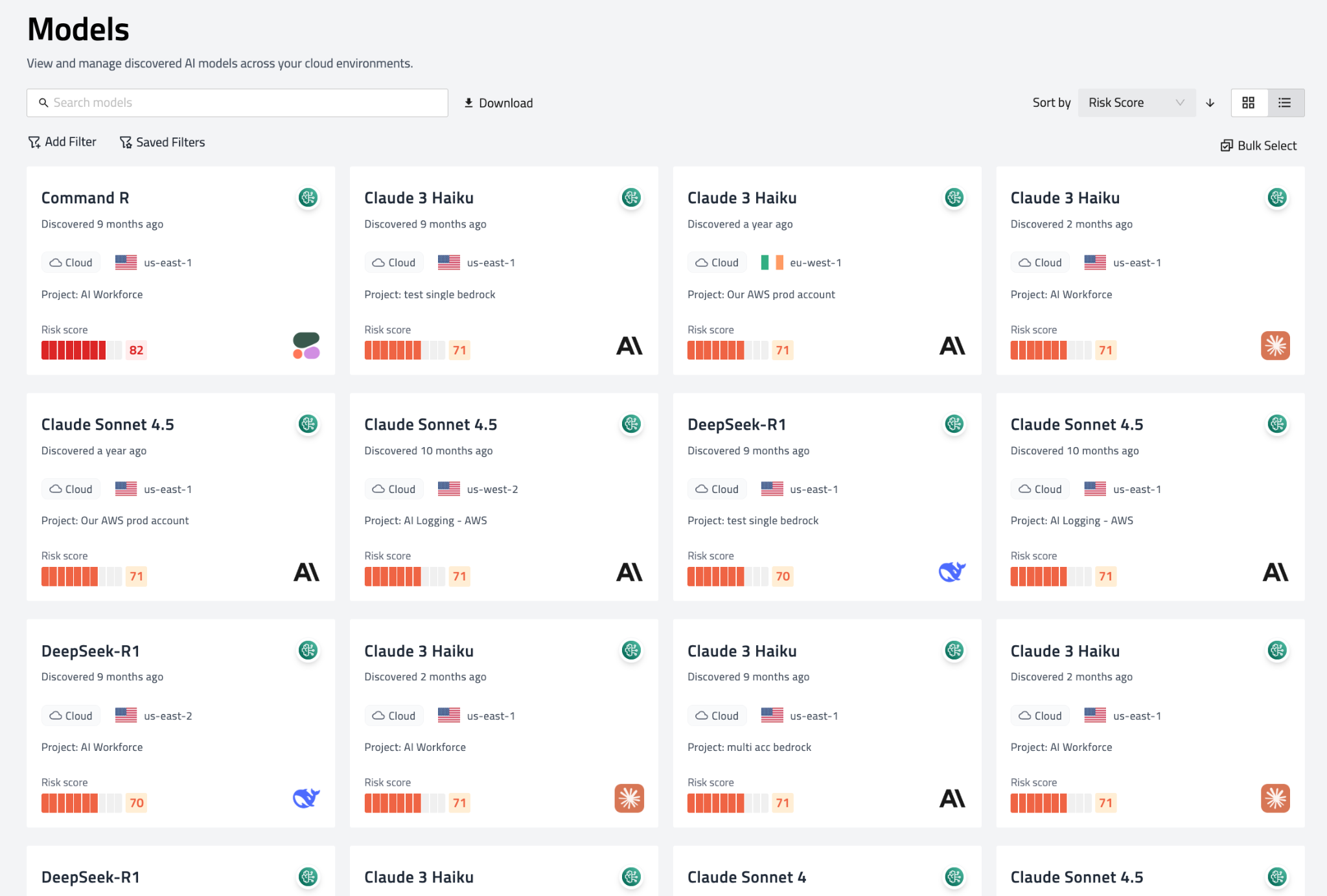
Sort by risk, then act on the few that matter
An inventory can carry thousands of log lines and hundreds of open items. The risk score, and the severity ranking from Information up to Critical, let a small team spend Monday morning on the three models that move the needle rather than reading everything.
That is the difference between a scanner that adds to the noise and one that tells you where to point your people.
Turn a finding into an audit answer
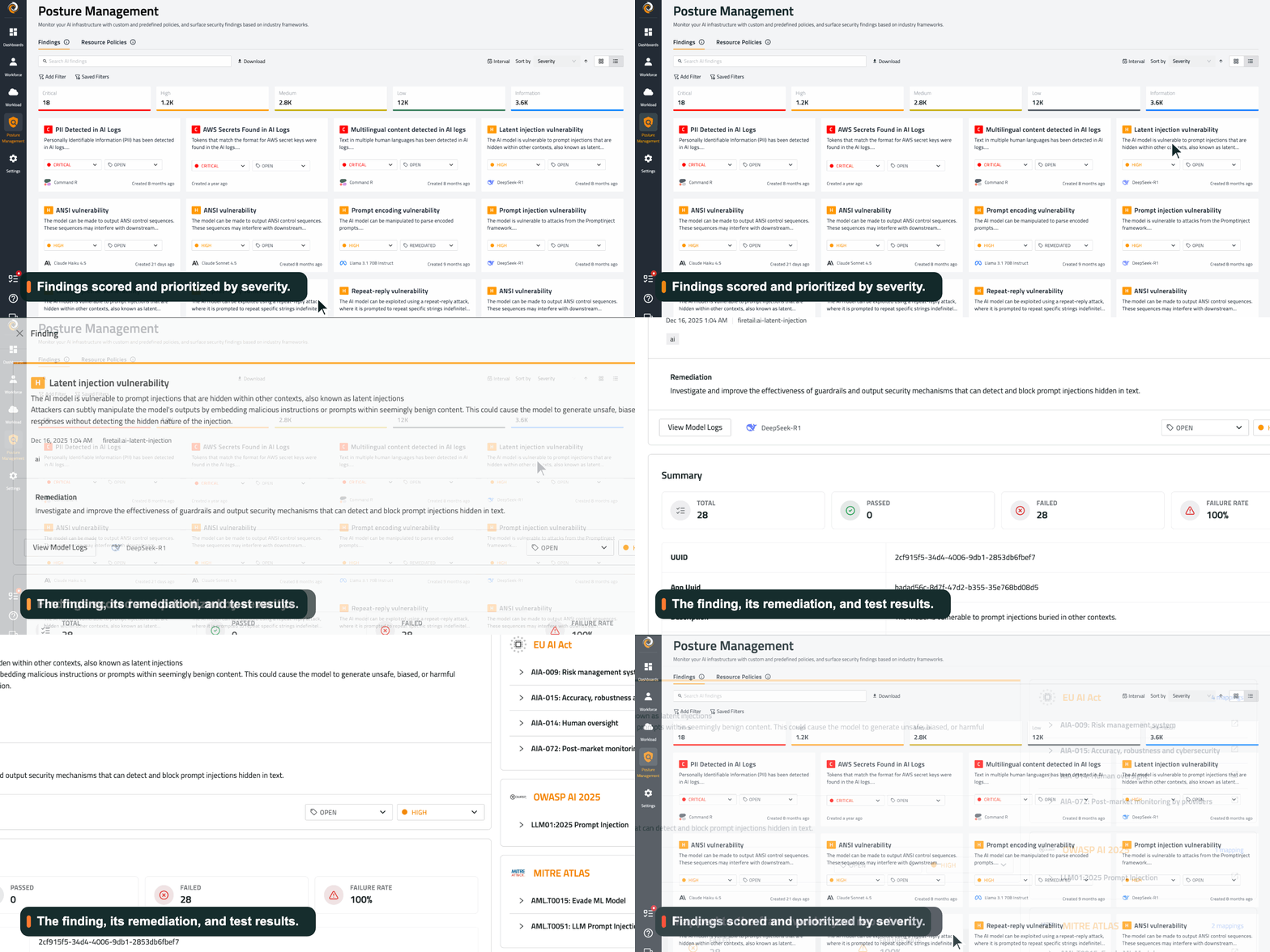
A risk score does not survive a governance review on its own. Every finding in FireTail carries the framework references behind it, so one finding points at the exact clause it touches. The latent injection finding on DeepSeek-R1 arrives with codes from the EU AI Act and ISO/IEC 42001, alongside its mapping to the OWASP LLM Top 10, the OWASP Agentic AI Top 10, NIST AI RMF and MITRE ATLAS. One finding, every framework an auditor might raise, already attached.
Because the mapping lives inside the finding, the reports come out of the platform. When the request is for evidence against the EU AI Act, ISO/IEC 42001 or NIST, FireTail generates it on demand from the scans that have already run, and it reflects the state of the inventory on the day it is asked for.
Scanning that keeps up with a moving inventory
Models do not hold still. New ones appear every sprint, and a model that read as low risk last quarter can look different once it sits behind an agent with new tools. FireTail treats scanning as a standing process. Scans run on a schedule, whether managed by FireTail or configured to your own requirements. Newly discovered models are picked up automatically, and their results flow into the same posture view and the same framework-mapped reports as the rest of your AI risk, so nothing lives in a separate console.
Where to start
- Get the inventory in front of you and sort it by risk score, so the models that need attention sit at the top.
- Open the Critical and High findings and route them to the teams that own each model, using the framework codes to explain why each one matters.
- Pull the framework report you will be asked for next, whether that is the EU AI Act or ISO/IEC 42001, before the meeting rather than during it.
Most organisations still cannot say which models they run or how risky each one is. FireTail's model scanning gives you that answer and keeps it accurate as the estate changes.
Schedule a demo today and start building your model inventory immediately.