
Your security stack needs AI observability to see what AI is really doing
FireTail delivers observability across all AI systems and usage through two collection pipelines that feed one centralized audit trail
Your organization has strong controls already. Endpoint detection watches processes and files. DLP inspects what leaves the network. Secure web gateways and CASB tools inventory the SaaS your teams use. On paper, coverage looks complete.
Then someone pastes a customer contract into a chatbot, an engineer sends a stack trace with live credentials to a coding assistant, and a team wires an internal document store into an agent that drafts and sends on its own. None of it arrives in a shape your tools can read, and none of it lands in a record you could hand to an auditor. That is the AI visibility gap: no single audit trail of what AI was used, by whom, at what cost, and with what risk, across both the tools employees use and the agents you have built.
Why your current stack cannot see it
The problem is not weak tools. It is that AI activity does not present itself in the shapes those tools were built to read. Endpoint detection understands processes and files, not the quarter's revenue figures a user typed into a browser tab. DLP watches known channels and file movements, but a prompt is not a file and a chat session is not an upload. CASB and secure web gateways catalog sanctioned apps, yet AI now ships inside apps you already approved: the productivity suite, the design tool, the notetaker, the CRM. Approval no longer maps to capability. And to the network layer, a call to a hosted model looks like ordinary encrypted traffic, so the part that matters, meaning the data that went in, the model that answered, and the action it took, stays invisible.
Meanwhile the exposure compounds and the reporting stands still. Three functions are already asking questions the current stack cannot answer: Security needs a complete, current inventory of all AI systems and activity; GRC needs a defensible answer to “what is AI actually doing here” before the next audit; Finance wants spend and consumption broken out by team and provider. Today those answers get assembled by hand, if at all.
What complete AI observability requires
Four things, and a tool that delivers only some of them leaves you where you started:
- Coverage at the point of use, across both employee tools and the AI built into your own applications and agents.
- Provider-neutral normalization into one common event model, so activity from different providers is comparable.
- A centralized, queryable audit trail keyed to identity, model, data, cost, and risk.
- Detection and enforcement, not just collection. Seeing sensitive data go into a model is only half the job.
How FireTail closes the gap
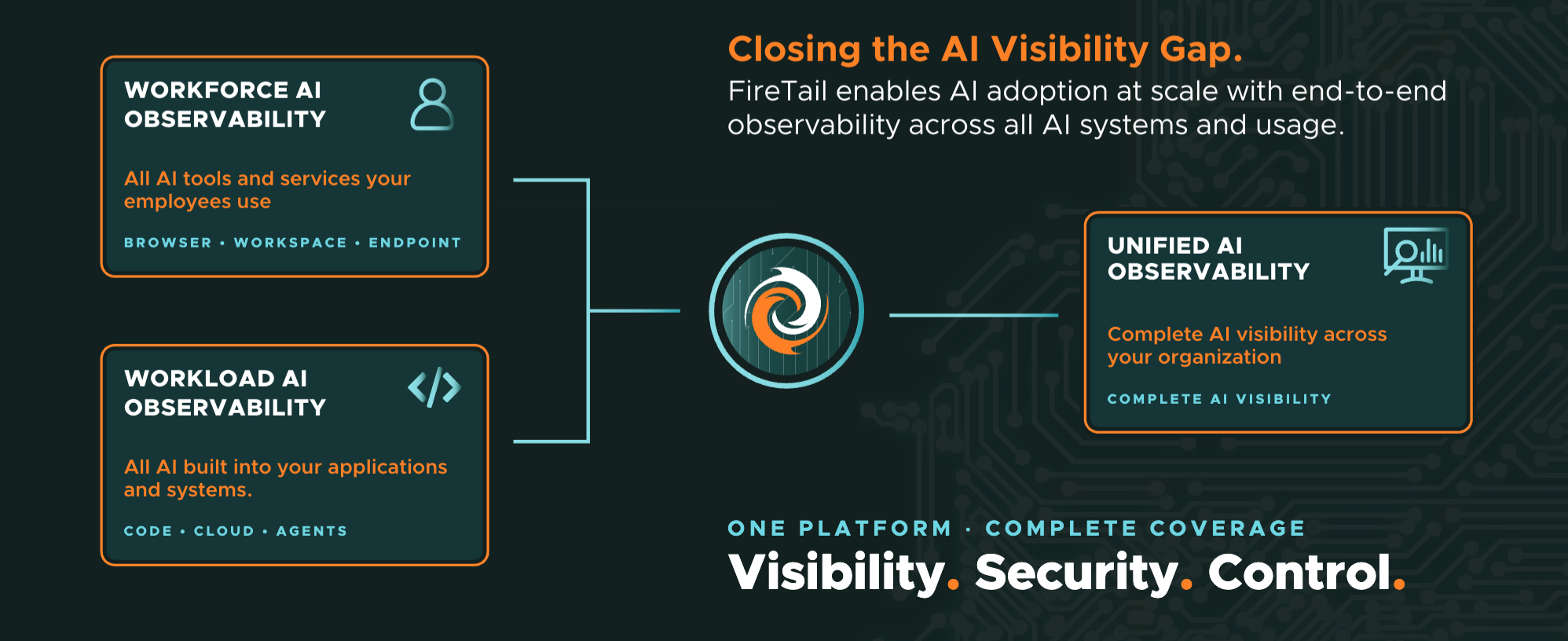
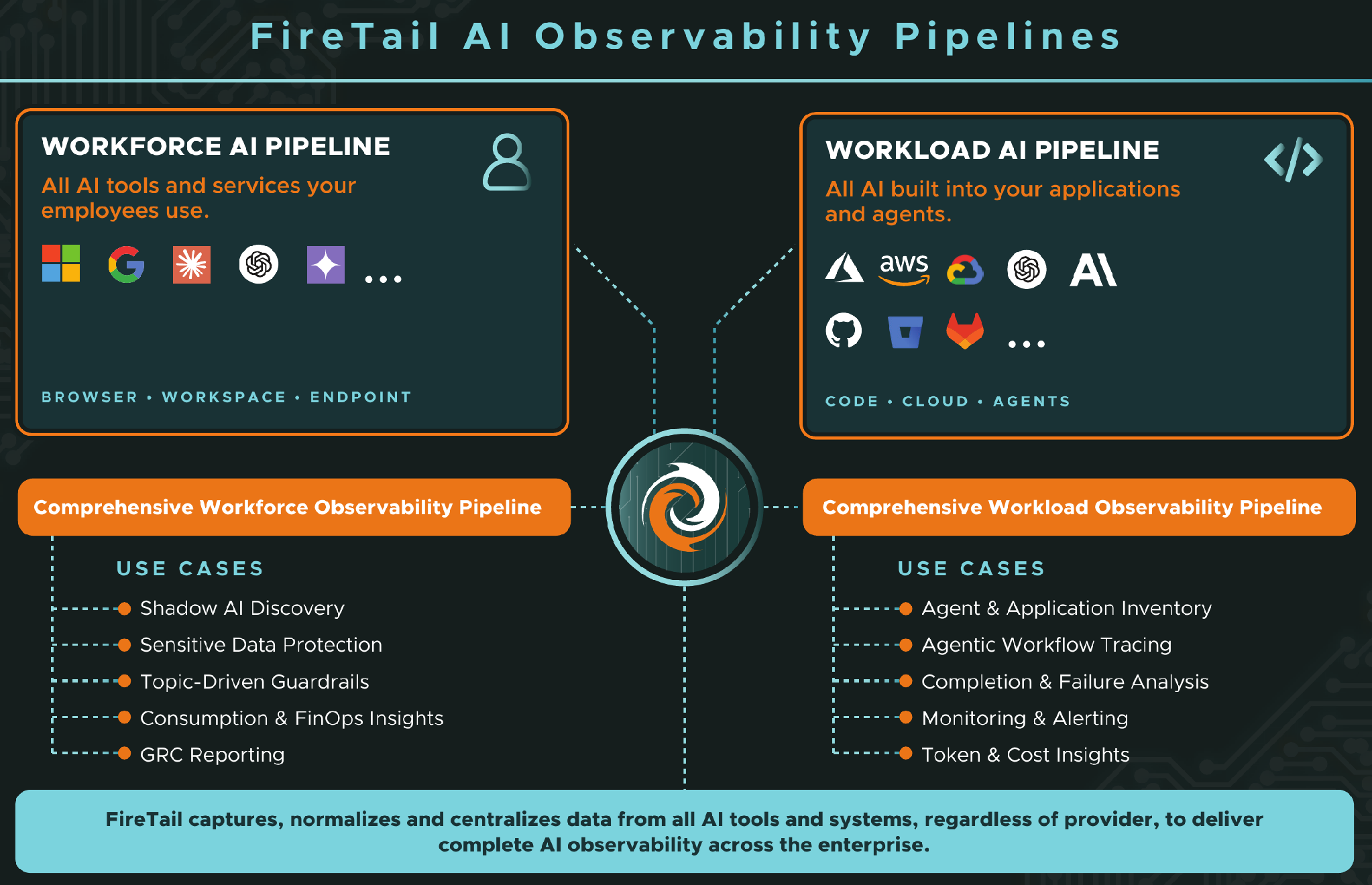
FireTail delivers observability across all AI systems and usage through two collection pipelines that feed one centralized audit trail. It captures activity where it happens, normalizes it regardless of provider, and centralizes it into a single record, so every function works from the same source of truth instead of reconstructing events after an incident.
Workforce observability
The workforce pipeline covers the AI tools your employees use, across the browser, workspace, and endpoint. This is where shadow AI lives, and the layer CASB and DLP consistently miss. It powers Shadow AI Discovery to surface unsanctioned tools as they appear, Sensitive Data Protection to catch source code, credentials, or personal data heading into a model, and Topic-Driven Guardrails to set policy on what can leave through AI. This is where legal and compliance teams get traction: privileged material and contract content can be kept from leaving through AI at the point of use. Consumption and FinOps Insights give Finance its per-team, per-provider breakdown, and GRC Reporting turns the same record into audit-ready evidence.
Workload observability
The workload pipeline covers the AI built into your own applications, instrumented in your codebase, collected from your cloud environments, and traced across your agents. As teams move from single model calls to multi-step agents, this becomes the harder half. An agent does not just answer; it reasons, calls tools, retrieves data, and acts, often in loops, and a single request-and-response view tells you almost nothing about that chain. FireTail provides Agent and Application Inventory so you know what you have shipped, Agentic Workflow Tracing for step-level visibility into how a result was reached, Completion and Failure Analysis for where agents break, Monitoring and Alerting for problems in motion, and Token and Cost Insights to keep production AI economics attributable.
One audit trail, three answers
A unified record means three separate conversations finally share one set of facts. Security gets an inventory that stays current on its own. GRC gets defensible, evidence-backed answers for an ISO 42001 audit, a NIST AI RMF exercise, or an EU AI Act obligation. Finance gets spend it can attribute to a team and a provider, the difference between managing AI like a line of business and treating it as an unbounded cost.
AI is now a cost center, a security risk, and a compliance concern at once. Understanding all three starts with seeing them, and that starts with one audit trail instead of none.
See your own AI activity
The fastest way to understand the gap is to look at what is already happening in your environment. Schedule an AI Assessment. Get a complete inventory of AI usage across your organization in 15 minutes. Visibility. Security. Control. One platform, complete coverage.

.png)