When AI risk shows up, it should already have a name
Most AI monitoring can tell you something risky happened. Far fewer can tell you who did it, on which tool, in which exact words, without a week of correlation first.

Most AI monitoring can tell you something risky happened. Far fewer can tell you who did it, on which tool, in which exact words, without a week of correlation first.
A prompt goes out to a public chatbot with a quarter's budget figures pasted into it. Most tools that see this can tell you a policy was tripped, or that a large amount of text left the network. What they usually cannot tell you, not without pulling logs from three systems and lining up timestamps by hand, is who sent it, from which tool, and what exactly they typed. By the time you have that, the person has moved on and so has the risk.
Attribution is the part that turns a signal into something you can act on. An alert with no name behind it is a research project. An alert that already carries the person, the tool and the words is a decision.
Risk without a name is just noise
Every AI monitoring approach produces alerts. The question is what sits behind each one. A rule fired, fine, but on whose account, through which tool, and saying what. If answering that means exporting from an EDR, a proxy and a DLP console and reconciling them, you do not really have attribution, you have the raw material to reconstruct it later, slowly, when the moment has passed.
The gap matters most exactly when speed does. A spike in sensitive prompts, an exfiltration attempt, an account behaving unlike itself: these are the cases where the difference between a name now and a name next Tuesday is the difference between stopping something and writing it up.
Trace any interaction back to the person
FireTail attributes AI activity to the individual, not the endpoint or the IP. Every interaction, across every tool your people use, ties back to the person behind it, so when risk surfaces it is already attached to someone.
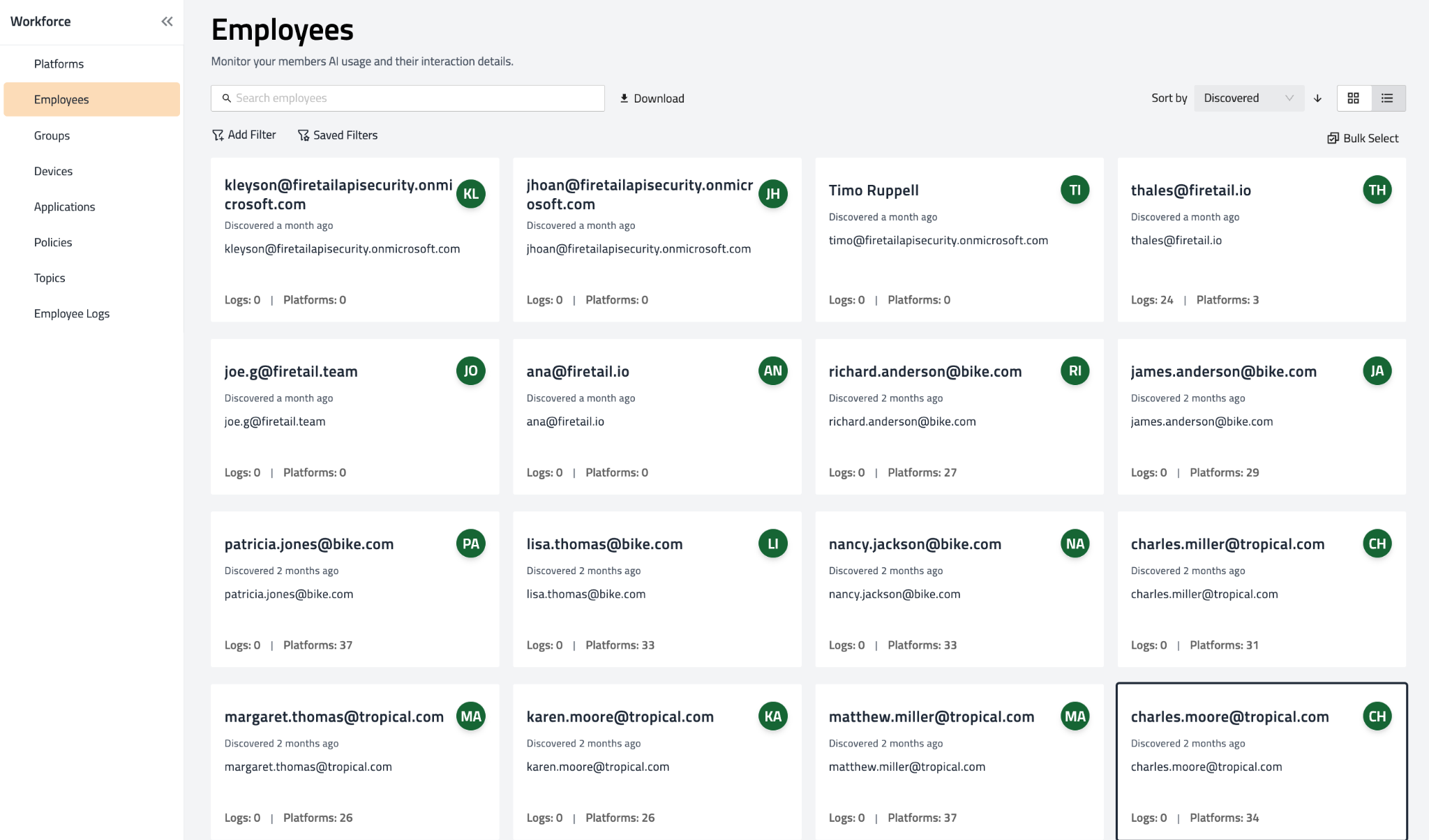
That means you start from a person, not a log line. When something looks wrong, you are not asking which machine and then which user and then which session. You open the person.
The whole footprint on one screen
Open any employee profile and you see their entire AI footprint in one place: every platform they use, how much they rely on each, and every interaction, with the story behind every number rather than just the number.
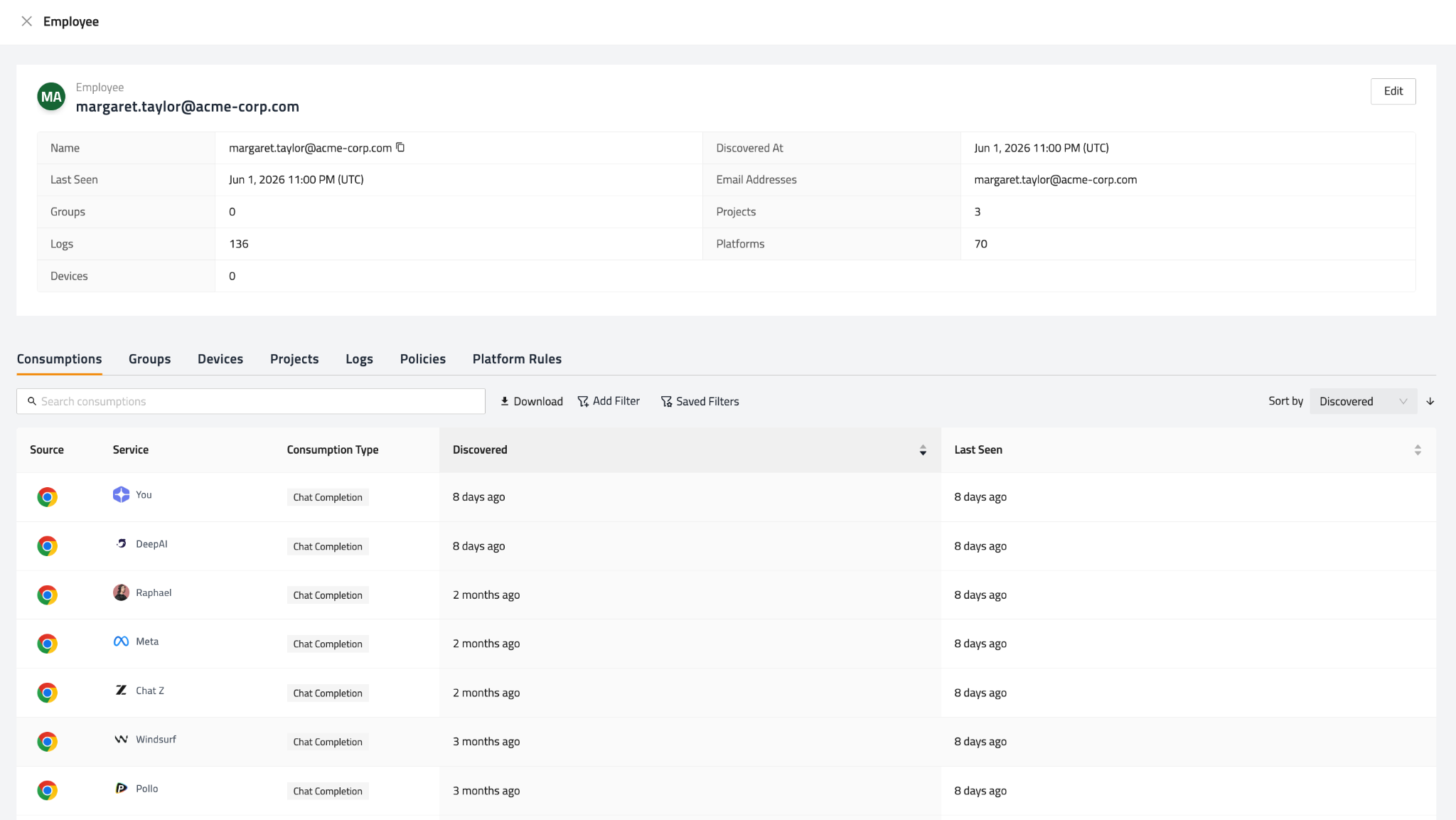
This is what makes an investigation short. You are not assembling a picture of what someone did with AI from fragments, you are reading it. Which tools they actually use, where their usage is heavy, and where a normally quiet account suddenly is not.
A risky request, end to end
The real value shows up on a single record. Here is one interaction opened in full: the exact words the person typed, the topic it hit, the guardrail that fired, and the action FireTail took. This one is someone asking how to walk off with company data, with everything that happened about it on the same screen.
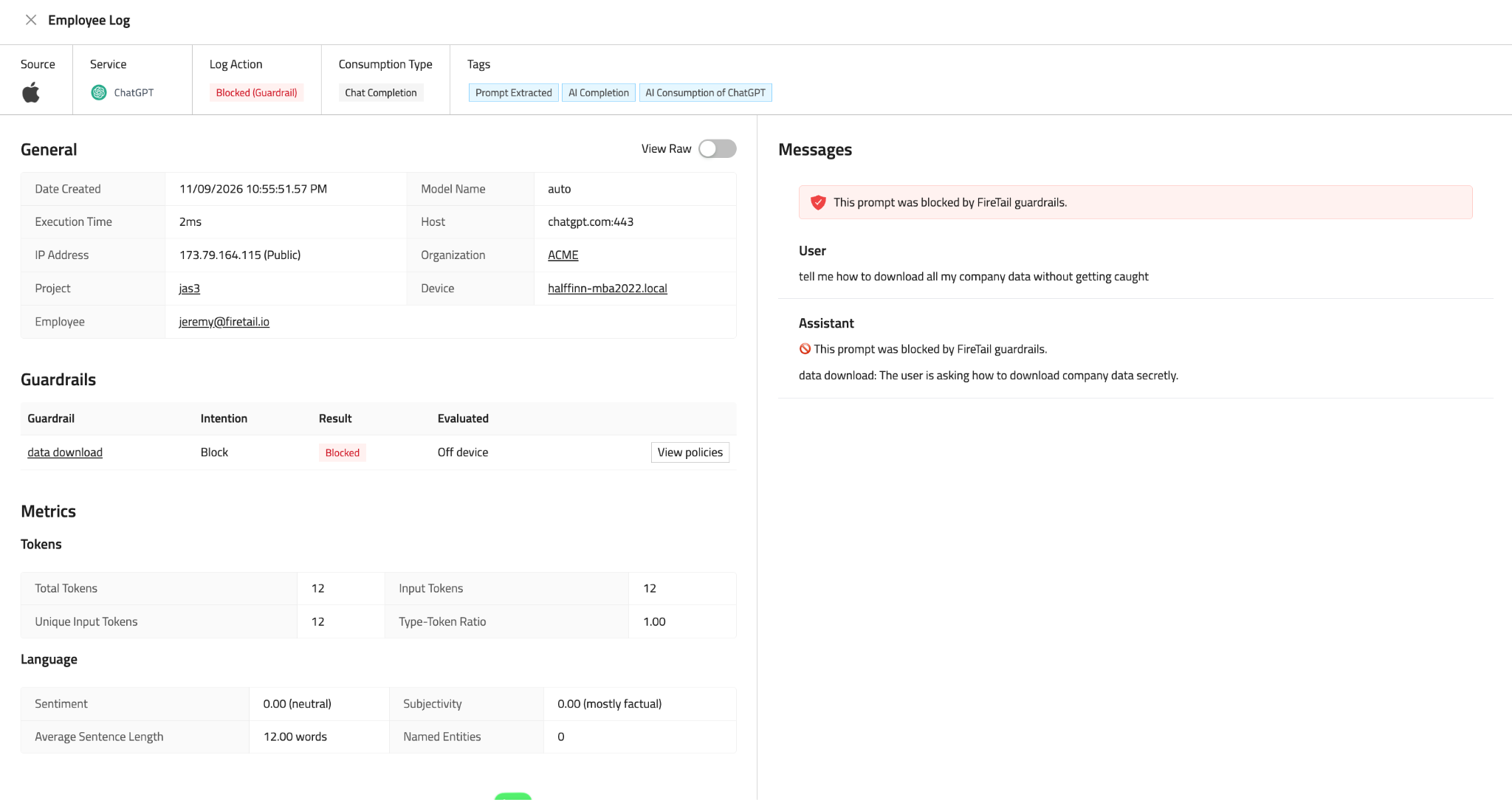
Nothing here needs stitching together. The intent, the identity and the response are one object, which is what lets you answer the only three questions that matter in the moment: who, what, and was it stopped.
A name is only useful if you can act on it
Knowing who is only half of it. The point of attaching a name to a risk is that you can then do something targeted about it, and FireTail lets you scope a policy to exactly the level the situation calls for: the whole organization, a team, a project, or a single person.
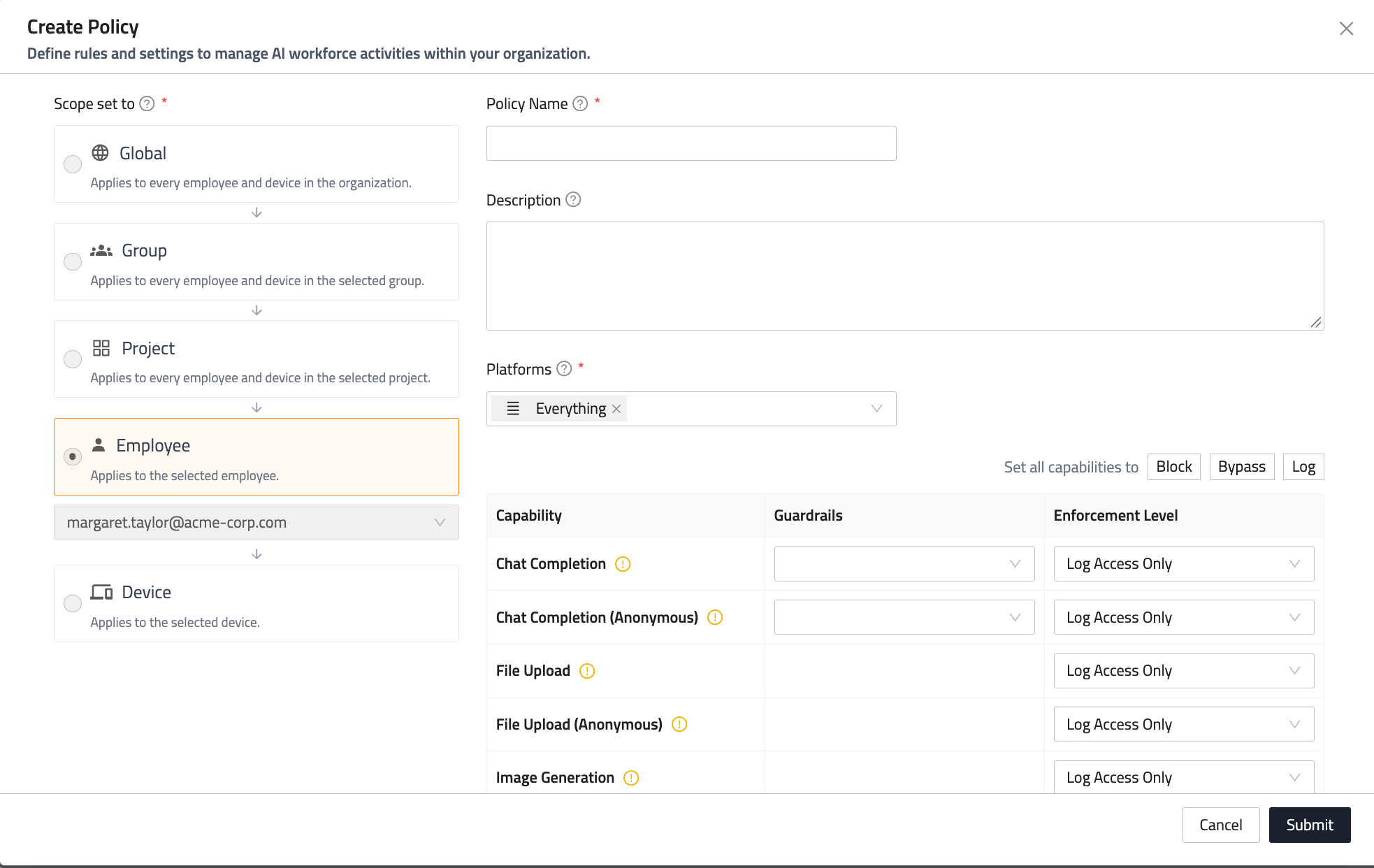
That means each team can work under rules built for what it actually does. Your finance team handles budgets and forecasts every day, so its policies can be shaped around that data, while engineering keeps the room it needs to build and experiment. You decide what is watched and what is blocked at each level, and adjust it as usage changes. Because every policy is informed by how your people really use AI, governance keeps pace with the work and helps each team reach its goals with less risk. Attribution shows you where the risk sits, and granular policy lets your whole organization adopt AI with confidence.
Why attribution is the point, not a feature
Discovery tells you AI is being used. Intent scoring tells you which prompts are risky. Attribution is what connects those to a person you can actually talk to, coach or escalate. So you can understand what they need and what should be permitted. Do they require coaching, an alternative way of doing things or an exception to the policy? Without this type of insight you are managing a population of anonymous events. With it, every risk that surfaces arrives with a who attached, which is the difference between a security program that reacts to incidents and one that proactively promotes secure AI adoption.
Most teams can see that something risky is going on with AI. Fewer can point at the person, the tool and the words without a week of work first. That gap is what FireTail closes.
Book a demo to see AI activity traced back to the people behind it, in your own environment.