Compliance evidence should be a quick query, not a static spreadsheet you constantly need to rebuild
The frameworks are not the hard part. Proving that what you actually run lines up with them, on the day someone asks, is.
The frameworks are not the hard part. Proving that what you actually run lines up with them, on the day someone asks, is.
It usually starts with an email like this one.
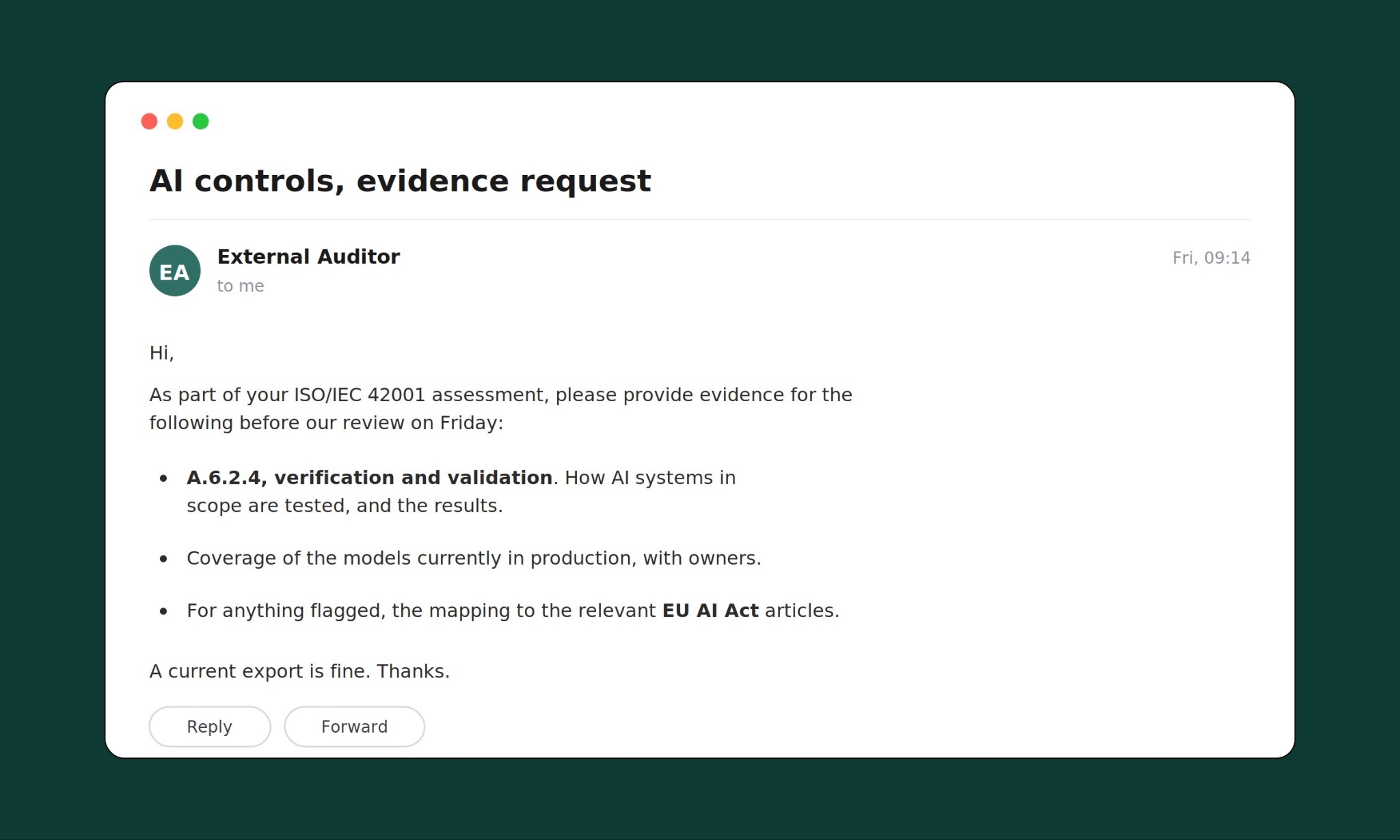
Nothing in that email is unreasonable. It is also the start of many lost hours. Someone pulls findings from one console, the model inventory from another, opens a spreadsheet, and matches each item to the clause it touches by hand. By the time the document is finished, the estate it describes has already changed.
That is the real state of AI compliance for most teams. Not a lack of frameworks, everyone can name those, but a lack of evidence you can produce on demand. Compliance lives as a periodic scramble instead of a live inventory and audit trail that you can query quickly
It does not have to work that way, and the shift is a small one to describe. Evidence should be a query against the live state of your AI, not a document you reassemble under deadline. Everything below is what that looks like in practice.
What each framework actually asks you for
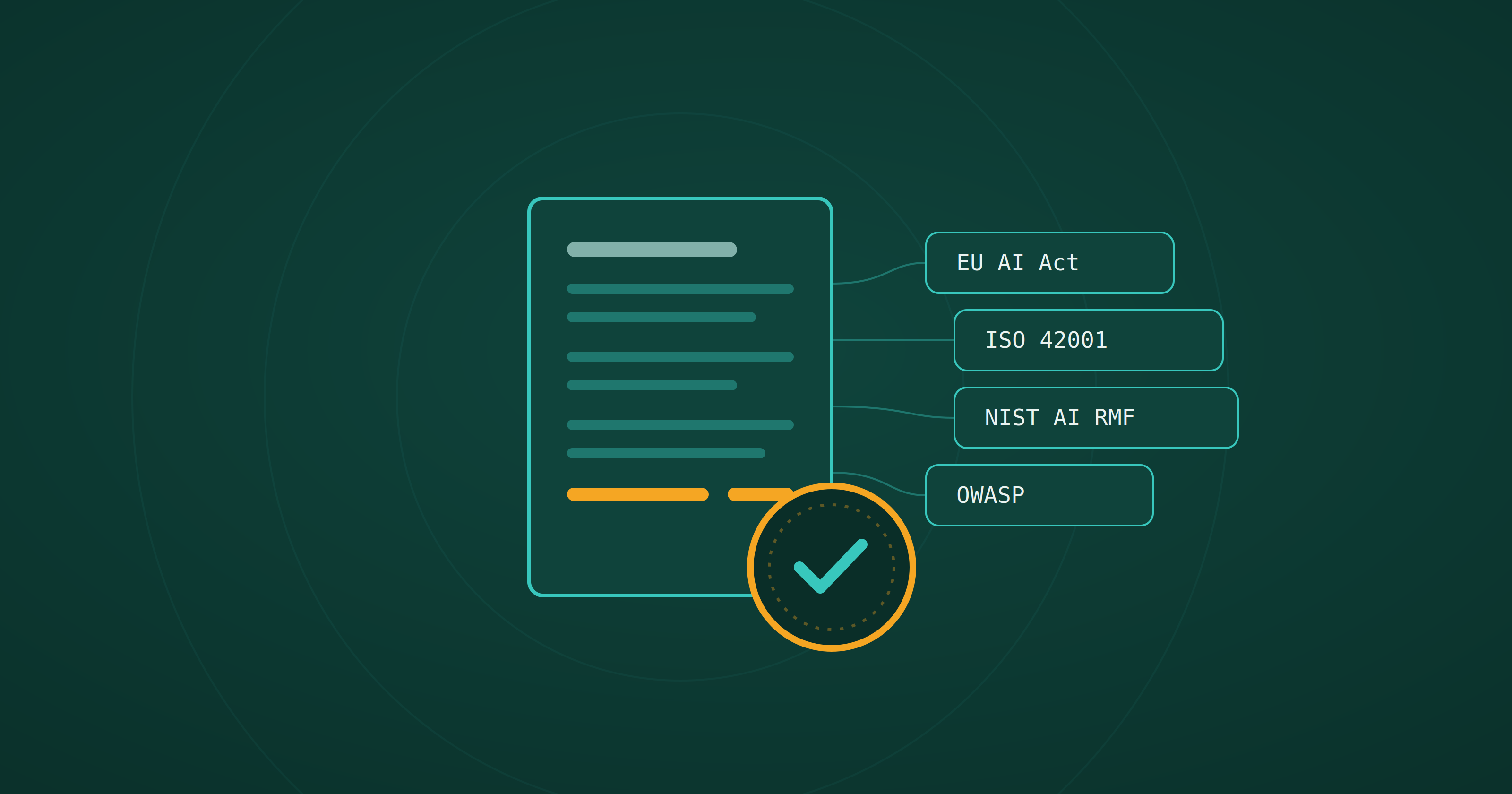
The frameworks landing on AI do not overlap neatly, and none of them can be satisfied by a policy document. Each asks a question about what your AI is doing right now.
Tie a weakness to the adversary technique it maps to.
Read together, the pattern is clear. Every one of these is a question about your live estate, not your intentions, which is exactly why a written policy never survives the review.
One clause, end to end
The abstract claim that a tool "maps to frameworks" is easy to make and hard to trust. So here is a single finding walked the whole way through.
FireTail scans a model in your estate and raises a latent injection finding on it, rated high. On its own that is a security result. What makes it an audit answer is what travels with it: the finding carries the exact clauses it touches, across every framework at once.
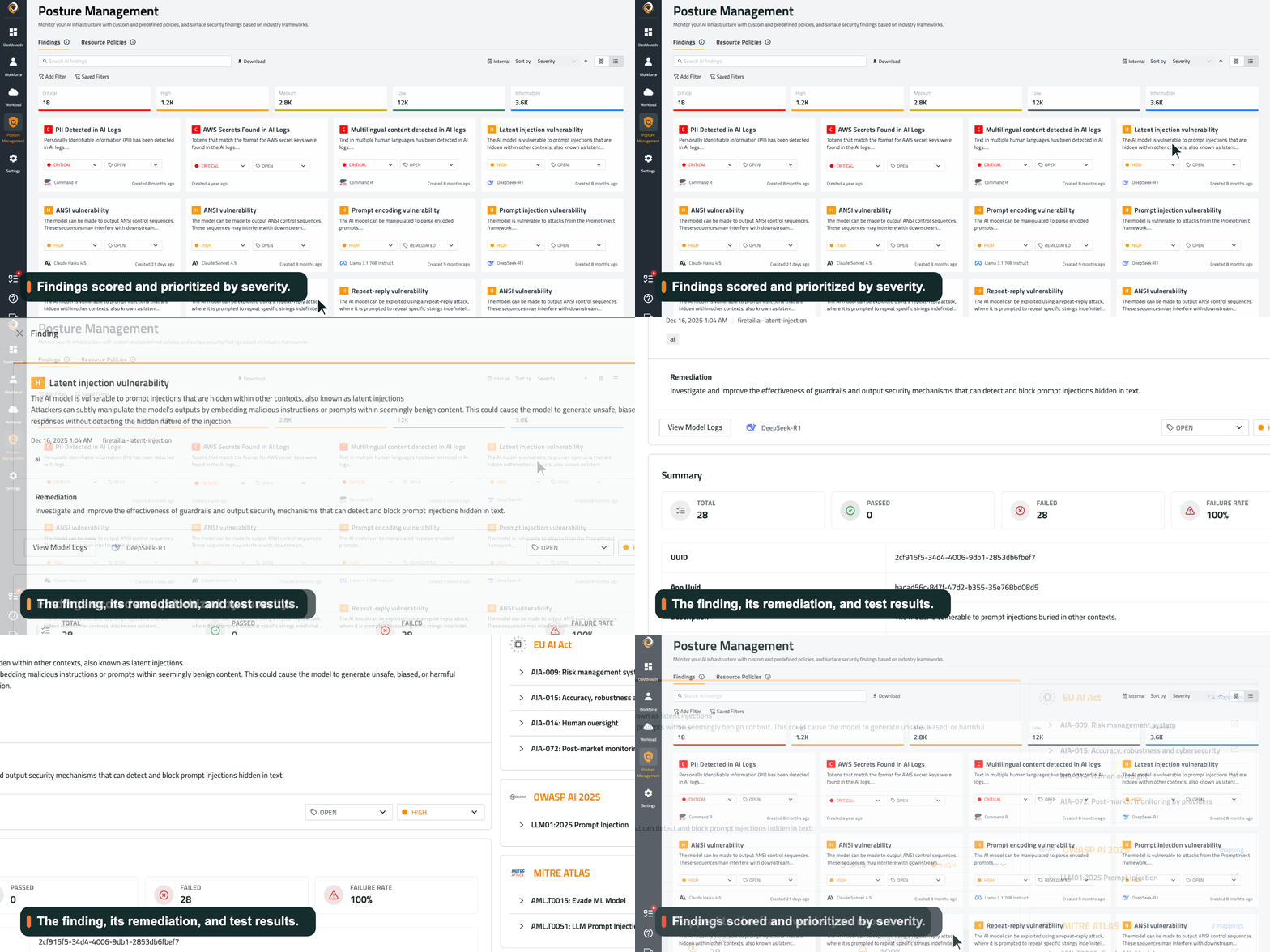
Now the ISO 42001 auditor asks how you meet A.6.2.4, verification and validation of the AI system. You do not go hunting. That clause is already attached to this finding, and to every other finding that bears on it, with the model, the severity and the date. The same finding answers the EU AI Act accuracy and cybersecurity obligation under AIA-015, the OWASP prompt-injection entry, and the MITRE technique, because the mapping was generated once, with the finding, rather than reconstructed per audit.
Because it is generated with the finding, it also stays current. A model discovered next week arrives already mapped. Nobody maintains the crosswalk by hand, and it does not drift between audits.
Reports pulled from the estate as it is today
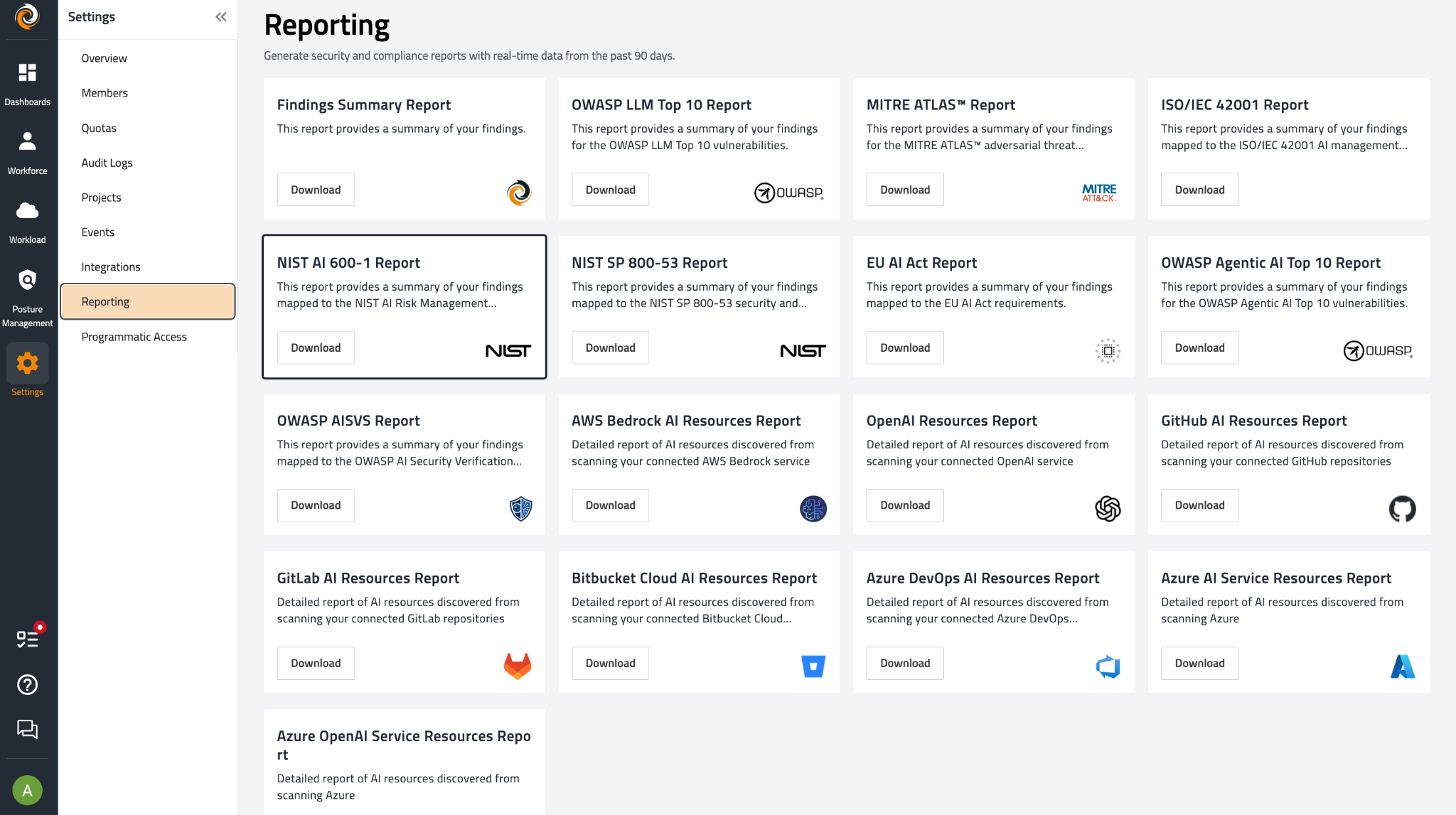
When the request is for evidence against a named framework, the report comes out of the scans that have already run. There is one for each of the frameworks that matter, the EU AI Act, ISO/IEC 42001, NIST AI RMF and SP 800-53, the OWASP LLM and Agentic Top 10s, OWASP AISVS and MITRE ATLAS, alongside per-service resource reports.
"An auto-generated report isn't an audit"
A careful GRC reader will push back here, and they are right to. A report a machine produced is not the same as an audit, and no serious team wants a black box handing them a green tick.
So this is worth being exact about. The report is not a verdict, it is evidence, and it shows its working. Every line traces back to the finding and the scan underneath it, which is what an auditor actually wants to interrogate. FireTail does the mapping and assembles the current picture. Reading it, judging it and standing behind it in the room is still your job. It does not make you compliant, and it is not a shortcut to a certificate. What it removes is the manual, always-stale layer between your live estate and the clause you are being asked about.
Why this shows up on the balance sheet
The clearest place this pays off is not the annual audit, it is the deal. A security questionnaire that used to hold a contract for three weeks while your team assembled evidence becomes something you answer the same afternoon, from reports that were already current. Compliance stops being the tax you pay before a sale and becomes something you can move through at the speed the sale needs.
Most teams still treat AI compliance as a document they rebuild under deadline. The frameworks were never the hard part. Turning your live AI estate into evidence you can produce the moment it is asked for is, and that is the part FireTail is built to carry.
Book a demo to see the framework reports run against your own AI estate.